Your Story Is Already There. Let's Discover How to Tell It.
The college essay process is about more than writing applications. It's an opportunity to reflect on who you are, what matters to you, and how your experiences have shaped you. Together, we'll uncover meaningful stories, develop authentic essays, and create a clear roadmap from first brainstorm to final submission.
Whether you're starting early or working against a deadline, I'll guide you through each stage of the process with personalized support, thoughtful feedback, and a focus on helping you communicate your ideas with clarity, confidence, and purpose.
The strongest essays don't come from trying to sound impressive. They emerge from curiosity, reflection, and a deeper understanding of your own story.
SUMMER COLLEGE ESSAY COACHING
Interior Design
✳︎
New Construction
✳︎
Renovations
✳︎
Remodels
✳︎
Commercial Design
Interior Design ✳︎ New Construction ✳︎ Renovations ✳︎ Remodels ✳︎ Commercial Design
College Essay Coach vs. College Counselor/Advisor
What Is College Essay Coaching?
Many students begin the college essay process believing they need the perfect topic, a dramatic life story, or a fully formed essay idea before they can get started.

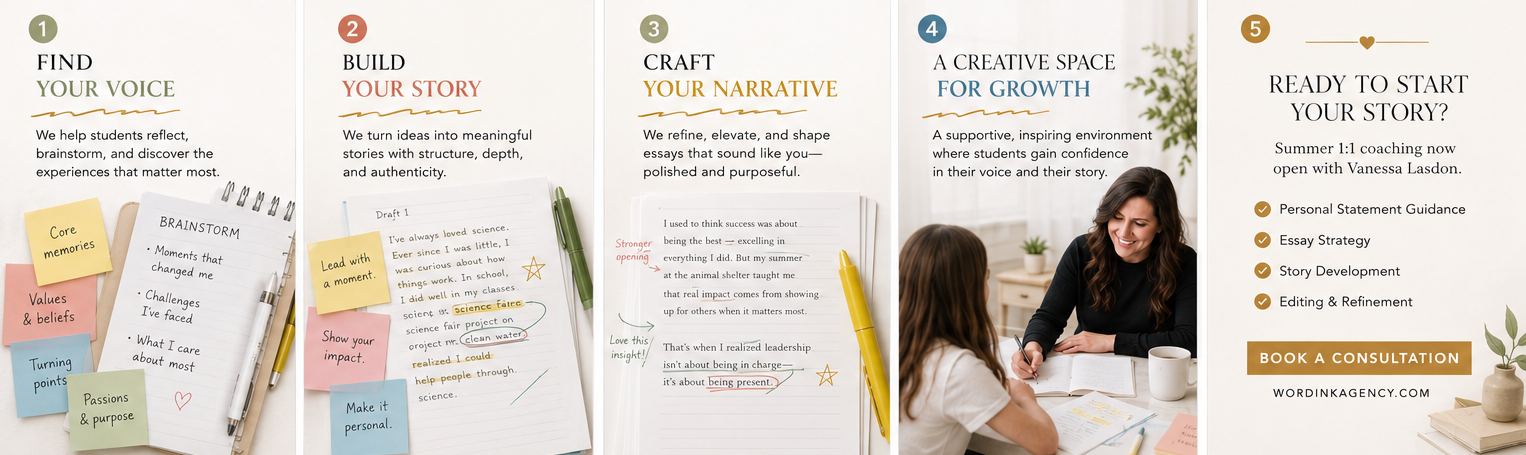
Big Ideas, Real Impact.
Big Ideas, Real Impact.
What Students Can Expect From Me
People buy people. Before they buy process. Before they buy timelines. Before they buy packages. They need to understand who they'll be working with. This section builds trust.
What Students Should Not Expect
Essays written for them
Manufactured stories or artificial narratives
Generic admissions formulas
One-size-fits-all essay topics
Last-minute magic
The strongest applications emerge from authenticity, reflection, and a willingness to engage thoughtfully with the process.
My Role in the Process
Every student arrives with a different story, different strengths, and different concerns about writing.
My role is not to write essays for students.
My role is to help students discover, develop, and communicate the stories that already belong to them.
Throughout the process, I serve as:
A Coach
Helping students navigate deadlines, decisions, and challenges throughout the admissions cycle.
An Editor
Providing thoughtful feedback, revision guidance, and writing support.
A Thought Partner
Asking questions, exploring ideas, and helping students uncover meaningful themes and experiences.
An Accountability Partner
Keeping projects moving forward through manageable next steps and clear expectations.
A Guide
Helping students navigate a process that can often feel overwhelming.
Overview of the College Essay Process
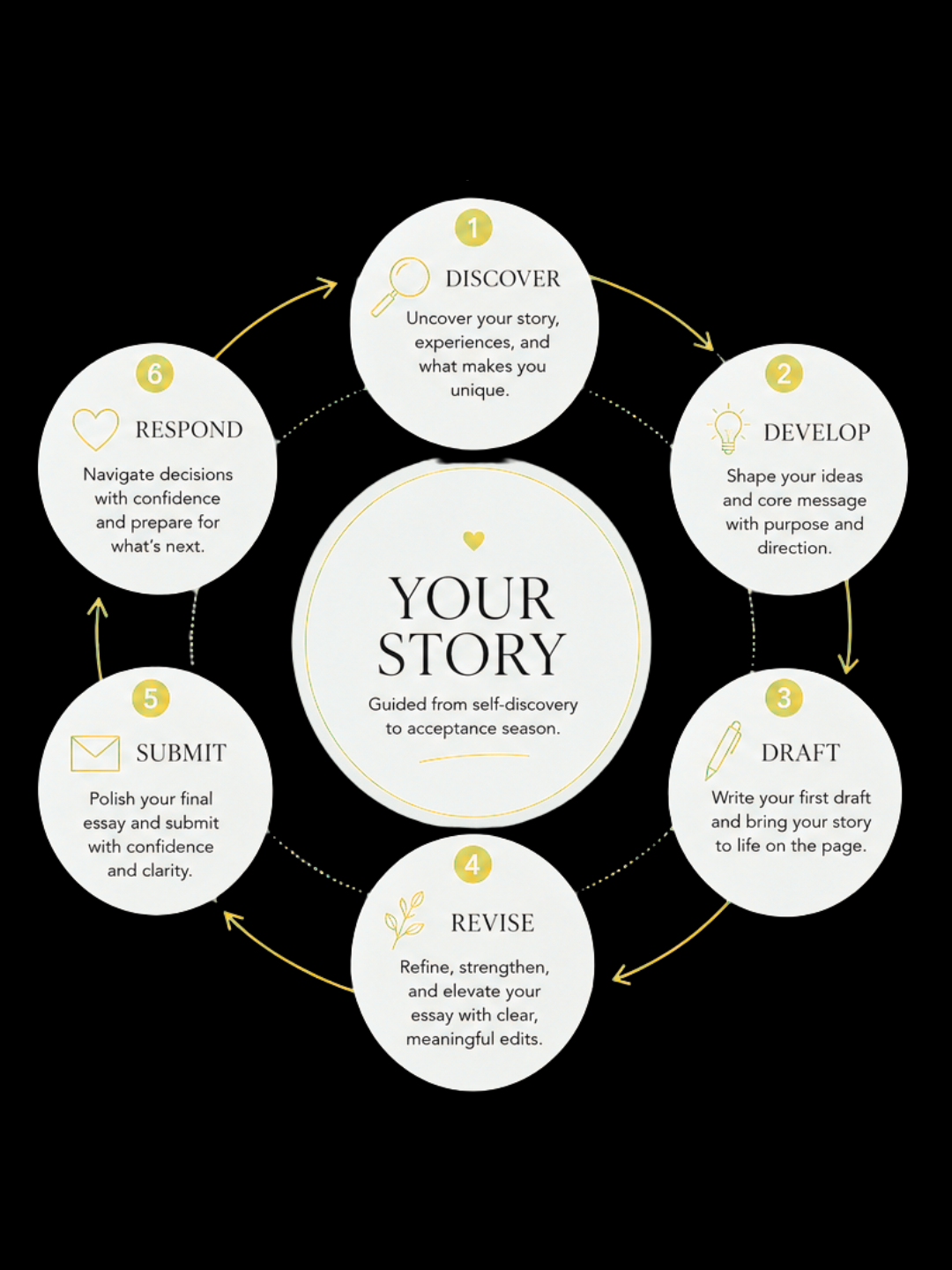
College Essay Coaching Timeline
-
Every strong college essay begins long before the first draft.
During this phase, we focus on discovery.
Students complete a detailed brainstorming questionnaire designed to uncover meaningful experiences, interests, values, challenges, relationships, accomplishments, and moments of growth. There are no perfect answers and no pressure to "get it right." The goal is simply to gather raw material.
From there, we begin a series of conversations and interviews to explore the most promising ideas. Together, we look for themes, patterns, and stories that reveal who the student is beneath the activities list and transcript.
This phase often includes:
Brainstorming exercises
Personal interviews
Topic exploration
Sample essay discussions
Reflection exercises
Personal statement outlining
First drafts and revisions
By the end of this stage, students are typically working with a strong personal statement draft that reflects their authentic voice and experiences.
-
Once the personal statement is underway, we begin tackling supplemental essays.
Unlike the personal statement, supplemental essays often require students to answer very specific questions about community, academic interests, values, future goals, and fit with a particular institution.
Many colleges ask similar questions in different ways, which allows us to build an efficient strategy for drafting and adapting essays across multiple applications.
This phase often includes:
Supplemental essay brainstorming
School-specific research
"Why This College?" essays
Community and identity essays
Academic interest essays
Leadership and extracurricular prompts
Drafting and revision
Our goal is to build a strong portfolio of essays that can be customized and refined as application lists evolve.
-
As deadlines begin approaching, our focus shifts toward refinement.
This is where we carefully review every essay, ensuring that each piece is clear, authentic, polished, and aligned with the student's overall application narrative.
We review:
Personal statement
Supplemental essays
Activities list
Additional information sections
Application consistency
Multiple rounds of revision often happen during this stage.
The goal is not perfection. The goal is clarity, authenticity, and confidence before submission.
Students applying Early Action or Early Decision typically finalize and submit applications during this phase.
-
Admissions season rarely unfolds exactly as planned.
This phase creates space for additional opportunities and unforeseen needs that may arise during the application process.
Possible projects may include:
Resume development
Scholarship essays
Honors college applications
Special program applications
Interview preparation
Activity list refinement
Additional supplemental essays
It is also common for students to encounter new opportunities, changing priorities, or additional application requirements during this period.
Flexibility becomes an important part of the process.
-
With early applications submitted, attention turns toward remaining schools and Regular Decision deadlines.
This phase often involves:
Completing additional supplemental essays
Revising previously drafted materials
Refining application details
Reviewing final submissions
Managing multiple deadlines
By this point, students have often developed stronger writing skills, greater confidence, and a clearer understanding of their own story.
Many students find that later essays become easier because they have already completed much of the deeper reflection earlier in the process.
-
Admissions decisions begin arriving, and some students may receive deferrals or waitlist decisions.
While these outcomes can feel discouraging, they are often opportunities to continue advocating for admission.
During this stage, we may work together on:
Letters of Continued Interest (LOCIs)
Deferral responses
Waitlist updates
Application updates
New achievements and accomplishments
Strategic communication with admissions offices
The goal is to help students respond thoughtfully, professionally, and effectively.
-
After months of work, decisions begin arriving.
This stage is both exciting and emotional.
Students may be celebrating acceptances, comparing options, evaluating financial aid packages, considering waitlist decisions, or preparing for the transition to college.
This is a time to reflect on how much growth has occurred throughout the process.
Regardless of the final destination, students leave with stronger communication skills, deeper self-awareness, and a greater understanding of their own story.
For families interested in getting an early start, March through May is also an excellent time for future applicants to begin the brainstorming and discovery process before the summer rush.
-
While many students first work with me on undergraduate college applications, the same coaching process can be applied to a wide range of future opportunities.
Additional projects may include:
Transfer applications
Graduate school applications
Medical school applications
PhD programs
Study abroad programs
Scholarship applications
Competitive summer programs
Fellowship applications
Professional and career-related essays
At its core, the process remains the same: helping students discover, develop, and communicate their story with clarity and confidence.
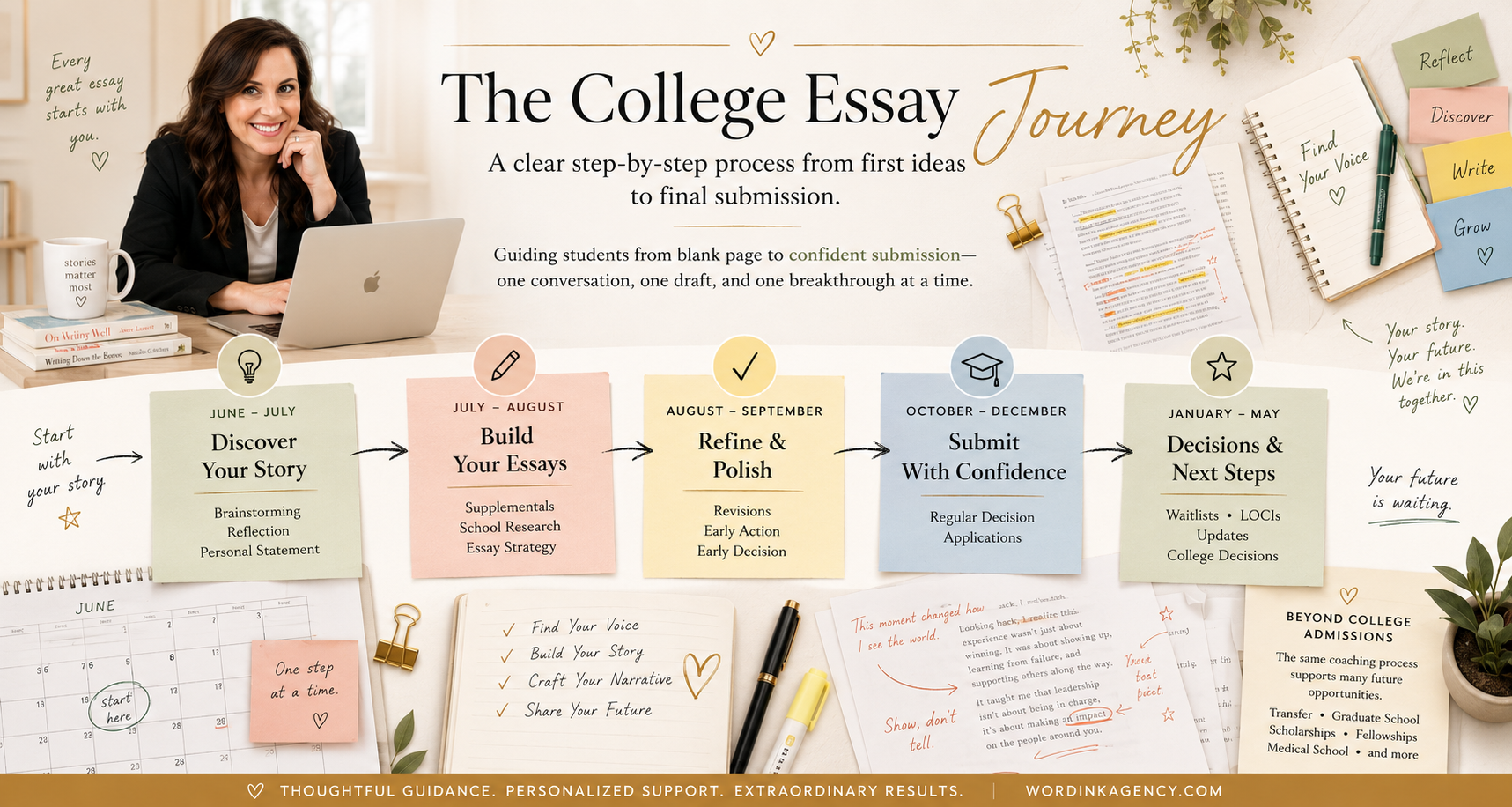
Optional Projects & Add-On Support
Sometimes the most meaningful work happens beyond the college essay. As students gain confidence and clarity about who they are and what matters to them, new opportunities often emerge.
Whether you're pursuing a passion project, developing a service startup, building a resume, or sharing your writing with a broader audience, these complementary add-ons can help you continue developing your voice, interests, and goals.
Examples:
Resume development
Passion projects
Scholarship essays
Writing contests
Publications
Service initiatives
SAT support
Transfer applications
Graduate school applications
College Essay Coach vs. College Counselor/Advisor
What's the Difference?
Families are often surprised to learn that a college counselor and a college essay coach serve very different roles in the admissions process.
A college counselor or advisor typically helps students build and manage their overall college application strategy. They may assist with college lists, admissions requirements, testing timelines, application platforms, financial aid resources, and admissions planning.
A college essay coach focuses specifically on helping students discover, develop, and communicate their stories through writing.
While there can be some overlap, essay coaching is its own specialized skill set.
A strong college essay coach helps students:
Identify meaningful topics and experiences
Discover themes and patterns in their lives
Develop authentic personal narratives
Brainstorm and organize ideas
Draft and revise essays
Strengthen voice, structure, and reflection
Navigate supplemental essays
Manage writing deadlines
Prepare Letters of Continued Interest (LOCIs) if needed
The goal is not simply to produce stronger essays.
The goal is to help students better understand themselves and communicate that understanding clearly to admissions readers.
Many families choose to work with both a college counselor and an essay coach because the two roles complement one another throughout the application process.
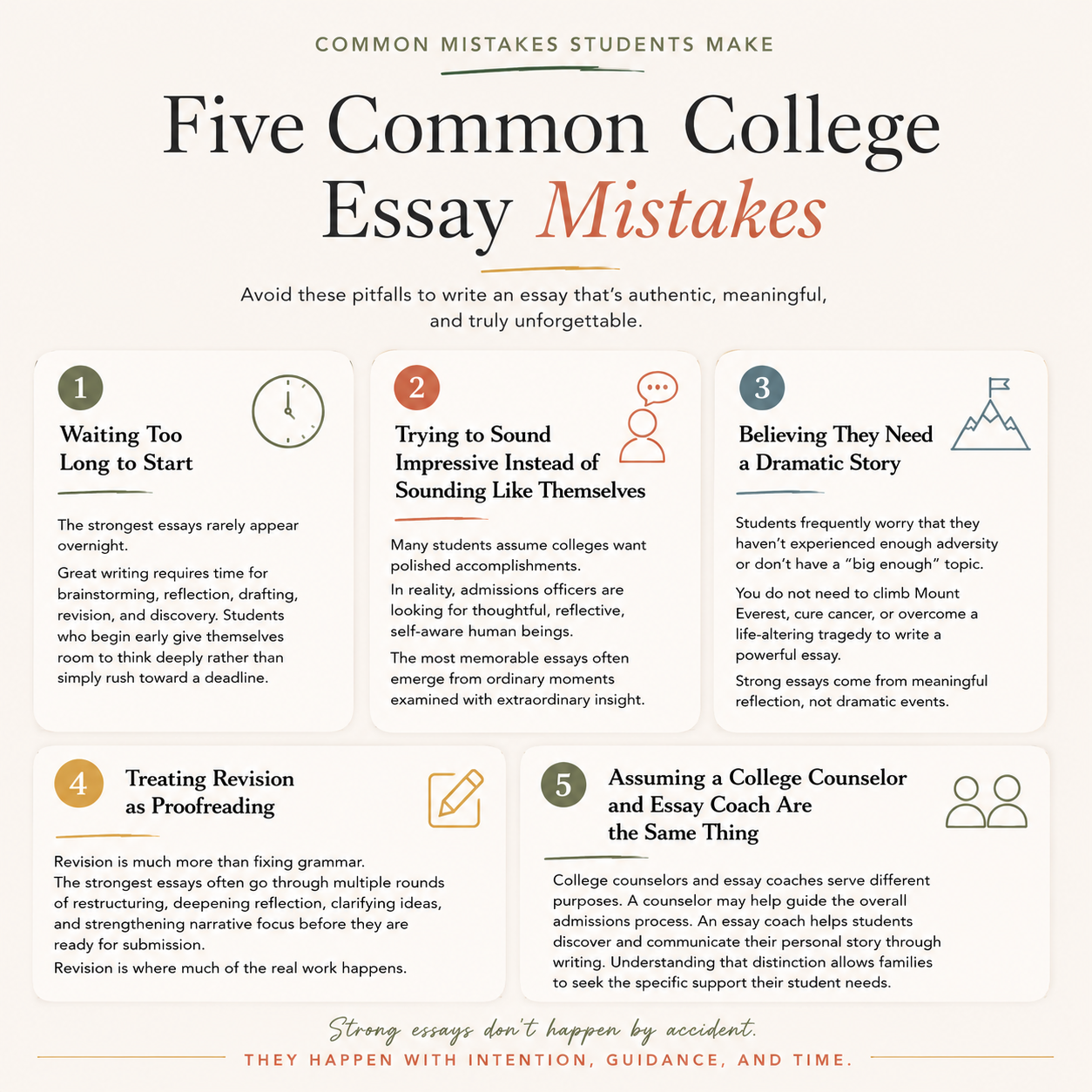
4. Treating Revision as Proofreading
Revision is much more than fixing grammar.
The strongest essays often go through multiple rounds of restructuring, deepening reflection, clarifying ideas, and strengthening narrative focus before they are ready for submission.
Revision is where much of the real work happens.
5. Assuming a College Counselor and Essay Coach Are the Same Thing
College counselors and essay coaches serve different purposes.
A counselor may help guide the overall admissions process.
An essay coach helps students discover and communicate their personal story through writing.
Understanding that distinction allows families to seek the specific support their student needs.
1. Waiting Too Long to Start
The strongest essays rarely appear overnight.
Great writing requires time for brainstorming, reflection, drafting, revision, and discovery. Students who begin early give themselves room to think deeply rather than simply rush toward a deadline.
2. Trying to Sound Impressive Instead of Sounding Like Themselves
Many students assume colleges want polished accomplishments.
In reality, admissions officers are looking for thoughtful, reflective, self-aware human beings.
The most memorable essays often emerge from ordinary moments examined with extraordinary insight.
3. Believing They Need a Dramatic Story
Students frequently worry that they haven't experienced enough adversity or don't have a "big enough" topic.
You do not need to climb Mount Everest, cure cancer, or overcome a life-altering tragedy to write a powerful essay.
Strong essays come from meaningful reflection, not dramatic events.

-
The ideal time to begin is during the spring or early summer before senior year. Starting early allows students time to brainstorm, draft, revise, and complete applications without unnecessary stress.
However, students can join the process at many different points throughout the year, including fall and winter deadlines.
-
Every student is different.
Some students need support primarily for their personal statement and supplemental essays, while others continue working together throughout the entire admissions cycle.
During our initial conversations, we'll develop a plan based on your goals, timeline, and application list.
-
We begin by exploring your brainstorming materials and getting to know one another.
The first phase of the process focuses on discovery: identifying meaningful experiences, uncovering themes, discussing goals, and generating potential essay topics.
Many students are surprised by how much material they already have once we begin asking the right questions.
-
This is one of the most common concerns students have.
You do not need to arrive with a topic.
The brainstorming and interview process is specifically designed to help uncover meaningful stories, experiences, interests, and insights that can become strong essay foundations.
-
No.
The essays must remain the student's work.
My role is to guide, question, coach, edit, and help students strengthen their writing while preserving their authentic voice.
-
Absolutely.
Parents often provide valuable memories, observations, and perspectives during brainstorming.
While the student's voice remains central to the essays, parents can be helpful collaborators throughout the process.
-
Yes.
In addition to the personal statement, I help students brainstorm, draft, revise, and refine supplemental essays for individual colleges and programs.
-
I continue supporting students through the later stages of the admissions cycle, including Letters of Continued Interest (LOCIs), waitlist updates, and additional application materials when appropriate.
-
Most meetings are conducted virtually using collaborative Google Docs.
Sessions typically last between 60 and 90 minutes and include live discussion, brainstorming, drafting, revision, and feedback.
Meetings are recorded so students and parents can access transcripts and summaries afterward.
-
Depending on your needs, students may receive:
Brainstorming exercises
Interview sessions
Essay drafts
Revision plans
Annotated feedback
Supplemental essay support
Application strategy notes
Activity list review
LOCI guidance (if needed)
Whether you're starting early, catching up, or navigating a deferral, you don't have to figure it out alone. Let's build a plan that works for your goals, your timeline, and your story.
Check out my CEC Instagram Highlights for more insights!